NOTE, This board is NOT available yet.
I had an email conversation with someone who was interested in a spud amp. What is a spud amp? The usual definition is an amp that uses one tube per channel. It comes from the phrase "one tuber" which was shortened to "tuber" which is another word for a potato, and so is "spud". Somehow the name stuck.
The emailer asked if I had tested any of the spud amps on the market. I explained that I rarely see other peoples amps any more since I just don't have time to do repairs or mods. Then he asked "Why doesn't Tubelab do a spud?" Well this question was asked two days before I had a three day weekend, so I decided to think about it. There are a few spud amps on the market currently. Most either use a dual dissimilar triode like the 6DN7 or 6EM7 to deliver 1 to 1.5 WPC, or a single high gain pentode like the 6CL6 or 12GN7 to deliver 0.5 to 2 watts. A triode - pentode like the 6BM8 could be used as well.
I decided that if I was going to do a spud it would be different. First it must be simple, really simple. Second, it must be useful to me. I could use a small amp for my computer, but I need more than 1 or 2 watts. Third, it must be small. Fourth, it must be cheap. And last, it MUST sound good. For it to be a true spud, there can be only two tubes.
Now that I have defined the amp, can it be built? Time for some experiments. It was the fourth of July, so a little fireworks may be in order. I have been using a tired old Tubelab SSE board to evaluate unknown tubes for potential audio use. I have wired dozens of different output tubes into this board and tested them. In order to make a true "spud" amp, I would need to use a multi section tube. I worked in a TV repair shop in the late 60's and I remember some big fat vertical output tubes used in Philco and Sylvania TV sets. The 6LU8, 6LR8 and the 6MF8 were fat bottled triode - pentode compactrons. The 6JZ8 was a much smaller triode - pentode compactron. The 6GF7 was a small dual dissimilar triode. It is like the 6EM7 but in a compactron bottle with an extra watt of dissipation on the big triode. I had experimented with all of these tubes back in the early 70's, and decided to test some of them again. I looked up the specs for these and some other vertical sweep tubes and found that the 6LR8 and the 6GF7 have the same pinout except for the non existent screen grid in the 6GF7. Could an amp be designed that worked with both of these tubes.
I used the same PC board to test some multi section tubes. How? Well we need to answer the question "Is it possible to build an amp almost entirely with clip leads?" I would have said NO before I did thi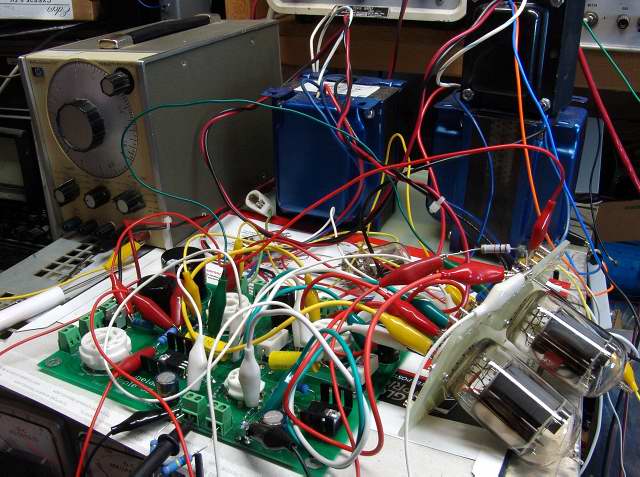 Do you believe that this actually works, and sounds good too!
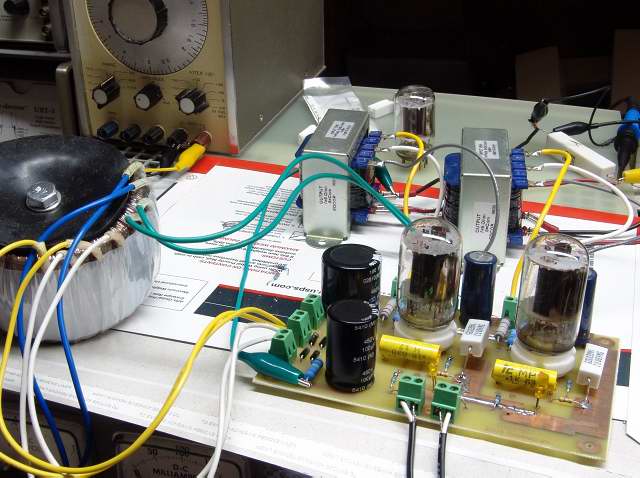
At the center of this mess is a SSE board. The tubes and a few other parts are mounted on a turret board and connected up with clip leads. This type of construction usually leads to building a giant unstable oscillator, but this amp works, and works good. I have referred to this type of design as a "furball" due to its similarity to something a cat might cough up!
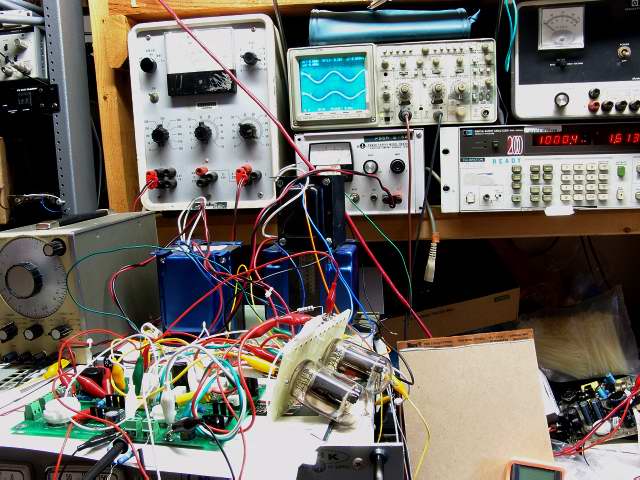
Here is a photo of the whole setup. The scope shows input (bottom) and output (top) of one channel. The audio analyzer shows 1.6% distortion at 2 watts. Clipping begins at 3.5 watts in triode and 5.5 in UL with the "big" tubes (triode - pentode). I can plug a set of dual dissimilar triodes into the same sockets (with some component changes) for far less power.
I got through the whole day on July 4th (Friday) and didn't explode anything. I did see some tubes glowing, and some that flat didn't work. But the "furball" that you see here just works! No tendency to oscillate at all, and it sounds good too. Now it I can only make it look good.
Remember the design criteria, small, simple, useful, sounds good, low cost. I got the sound down right, which is usually the first thing to work on after you solve the "it doesn't work" stuff. I needed to design a PC board that was small. It had to be easy to build, simpler than an SSE, and work as well as the "furball".
I spent most of Saturday in front of the computer working on the layout. By evening I had a prototype quality board ready to be made. The process to make a PC board involves some nasty chemicals that must be used in the dark, followed by cooking up a plate of acid on the stove. I waited till Sherri was asleep for that one. Finished this part late Saturday night. Sunday afternoon I had to drill all the holes in the board, and then it was ready for "stuffing", the process of soldering in all of the parts.
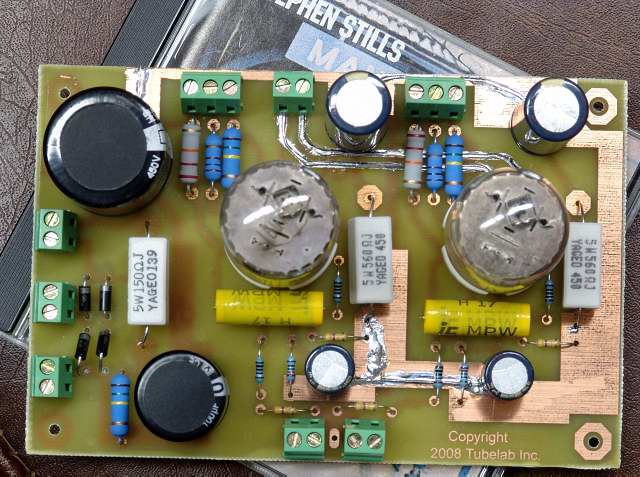 The photo shows the completed board. It occupies less area than a music CD. The PC board is 4 inches by 6 inches.
The board was populated with the same component values that were used in the "furball". I wired it up using the small 5K ohm Edcor OPT's in UL mode since they were more in line with the project goals. I also used an Allied 6K56VG transformer since I had one on my bench. It produces slightly more voltage than the power supply used with the "furball".
The amp worked on the first try with no tweaking. Tube dissipation was slightly over spec, but this was expected since I had planned for 300 volts of B+ and now had 320. No glow was visible in a dark room even after 4 hours of operation.
The amp measured quite good. Distortion was 3.05% at 5 watts, 0.88% at 1 watt. Clipping begins at 5.5 watts and 5% distortion is reached at 7.1 watts. Frequency response is 19Hz to 61 KHz at 1 watt. Power will be reduced somewhat when the tube is re-biased to a cooler operating point.
I listened to it for several hours last night. It sounds quite good. OPT saturation can be heard when playing techno or other bass heavy music at high volume. This can be fixed with larger OPT's, but that is not in line with the small and cheap goals. I plan to experiment a little further with this amp next weekend.
This was a three day diversion from my other projects. It was fun, and I didn't even blow anything up. I will stuff the entire amp into some sort of unique cabinet at a later date. My guess is that the whole amp could be built for under $200, not counting the enclosure. It is really a Simpler SSE.
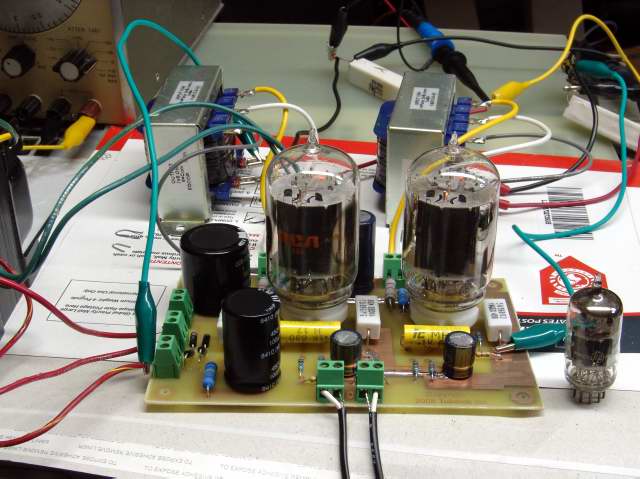 Here the amp is running with the "big" tubes.
The 12AX7 is for size comparison. The tubes in this photo are 6LR8's. The 6LR8 is a triode - pentode combination intended for TV vertical sweep. The amp was designed to work with 6GF7's as well. It is a smaller dual dissimilar triode also made for TV vertical sweep. It is similar to the 6EM7 or 6DN7.
 The amp with 6GF7's installed.
I put in the 6GF7's and tweaked up the amp. It works best with a lower B+ voltage of 250 volts. At this voltage, with the tube current set so that the tube was running right at the maximum dissipation. Under these conditions the output power varies between 2.5 and 3 watts depending on the tube. I tried about 50 different tubes. Like the 6EM7 there is a large variability in the gain from tube to tube. I replaced the resistor - capacitor combination in the cathode of the driver tube with an LED. This seemed to lower the variability a little.
The sound (and power level) reminds me of a trioded 6V6. It sounds really good, but there is just not quite enough power for my 87db speakers. Slightly more power may be available with a lower impedance OPT, but this usually sacrifices the sound quality.
The power transformer in this photo is an Antek 1T200. I get 249 volts of B+, just right.
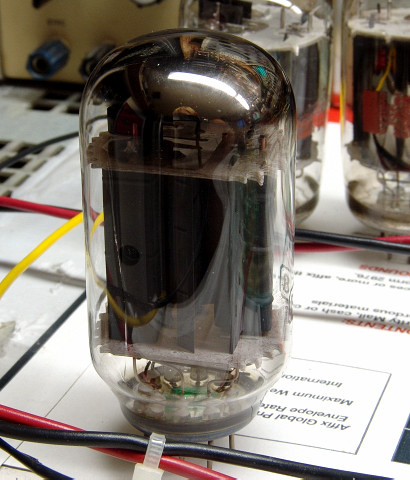
OK, it's time to blow something up.
I have thousands of tubes in my warehouse that were physically abused by some furniture movers that were hired to clean out an abandoned warehouse. Many were broken or damaged internally. These tubes were stored in boxes, exposed to the elements in Florida for several years and dumped into bins. They were loose tubes, not in their original boxes. Many were broken and new tubes were mixed in with used and broken tubes, but I got them for free.
I have a 21LR8 with a crack down the side. It is a Silvertone (Sears) branded tube. It is made in Japan. It does work, and doesn't exhibit signs of "gas". I used this one during the initial test and development of this amp. It looks like the crack has grown since I started using it. I have learned that cracked tubes like these are unstable. They can shatter when they get hot. I have an 833A with a similar crack. I am afraid to crank that one up. Likewise, I would be hesitant to rely on this one, so its test time. Lets see what these things can do. In the spirit of the 6AV5 testing, I want to find out if these tubes have any margin built into the specs.
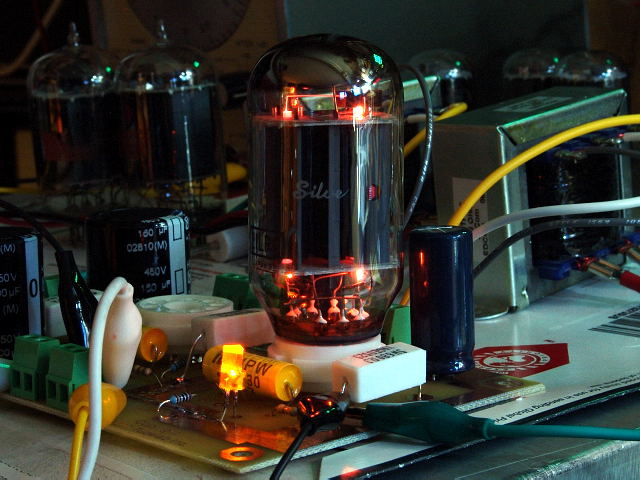
I have already been up to 400 volts of B+ in UL mode with these tubes, so I will start here. This puts about 355 volts across the tube. Power output is 8.5 watts at 5% distortion. The tube is not even getting excited, no glow on plate or screen. Tube dissipation is about 16 watts.
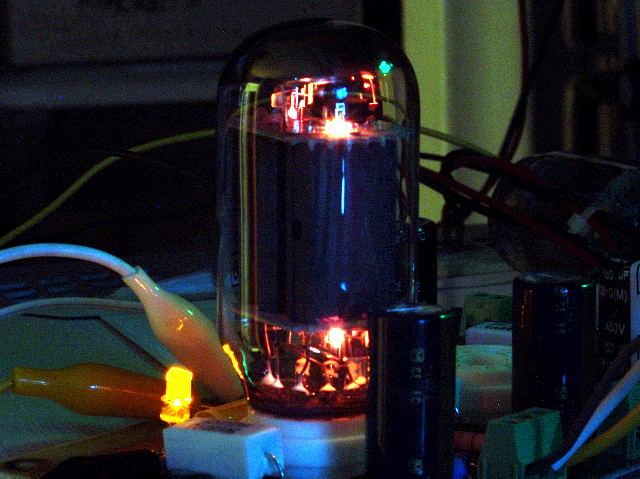
Next stop 450 volts of B+. 390 volts across the tube. This is max rated plate voltage, 100 volts above max rated screen voltage. Tube dissipation is 21 watts. I let it sit at this level for 10 minutes. It did not shatter, and there was no sign of runaway or gaseous glow. In fact there was NO glow on plate or screen. Power output is 10 watts at 5% distortion. I rotated the PC board to show the side of the plate that does glow when you really crank it.
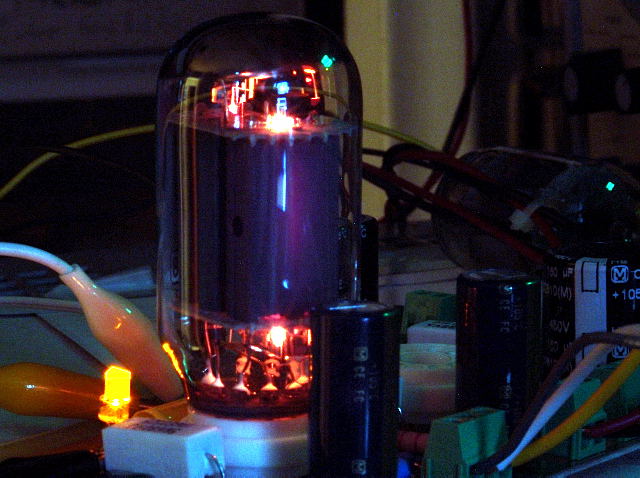
OK, I set the power supply for 500 volts! This puts 435 volts across the tube. The cathode current is now 93 mA. Power output is 12 watts at 5% distortion. This is a tube dissipation of about 28 watts (435 volts * .093 = 40 watts - 12 watts delivered to the load). There is a faint glow visible on the center of one side of the plate. There is NO glow visible on the screen grid, but there is some blue glow inside around the grids. This is to be expected at TWICE the normal rated dissipation. I let it run for about 5 minutes at this level. There were no unexpected events.
The cathode resistor is now dissipating 5.9 watts, it is a 5 watt resistor and I have had these fail before resulting in an exploded bypass cap. It makes a mess out of the PC board and stinks up the whole house.
My camera responds to infrared (it shows up pink) so the glow in the picture is worse than that seen with the eyes in a dark room.
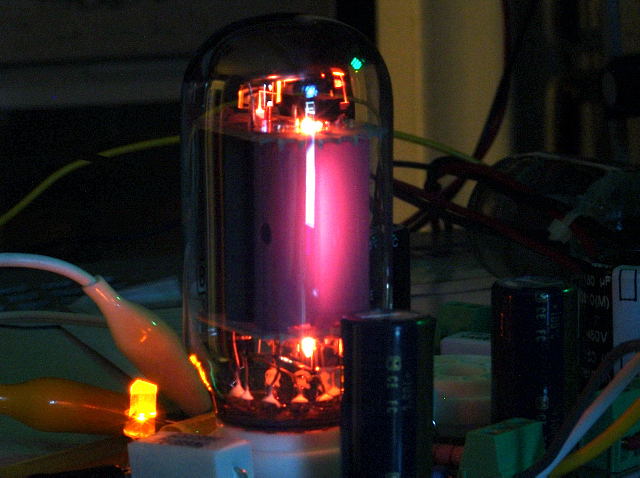
OK, time for worse case. Same conditions as before, but I turned down the audio generator so that the output power was now 0.1 watt instead of 12+ watts. Now the tube gets to eat all 40 watts that it is fed. No signal is always worst case dissipation in a class A amp. The photo is after about 2 minutes. I shut it off because things were getting really HOT!
NOTE, this is a sample size of ONE, and it is a Japanese tube. I decided to repeat some of the testing on some USA made samples that I have, but I didn't glow them as hard.
I tried two Sears branded Sylvania USA made 21LR8 tubes and three Sylvania 6LR8's. They consistently made about 1 watt less power and showed faint color at 26 watts of dissipation. They lit up brightly at 40 watts.
I tried one really crusty old looking RCA 21LR8 tube it appeared to be Japanese made. It made about 14 watts at 5% under the 500 volt test. It also barely glowed. When I removed the drive it developed a glow similar to the other Japanese tube.
I tried three RCA branded tubes that were made by GE. They behave like the Japanese tubes.
Both the RCA and Sylvania tubes glowed the brightest on the plate surface that faced the other tube section. I would expect this since the path to radiate heat is blocked. The Japanese tube glowed the brightest on the outside face of the plate.
All of these tubes exhibited even glow, no hot spots. This is good. Any hot spots on the plate can cause a quick tube death.
What does all of this mean? First off, it means that you don't have to worry about blasting the screen grid in UL, or if you slightly exceed the 300 volt rating. It also means that the 14 watt plate dissipation rating is at least conservative. I would have no problem running these tubes at 14 watts, maybe a little more. I plan to run a pair of 6LR8's at 18 to 20 watts to see what happens over a longer time.